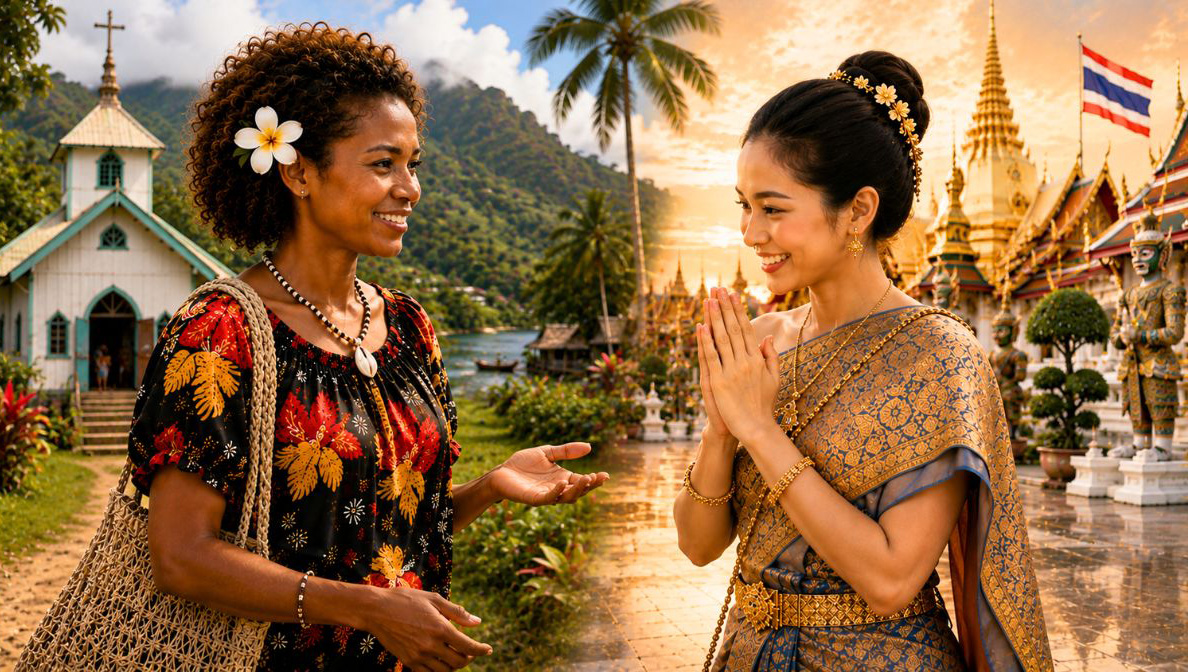
Truly Amazing! 🌺
Some countries teach us through speeches. Others teach us simply by being themselves.
In many Western countries, multiculturalism often asks, “How do we accommodate many cultures within one nation?”
Thailand seems to begin with a different question:
“How do we remain unmistakably Thai while welcoming the world?”
If Papua New Guinea is looking for examples of how to remain connected to the wider world without losing its soul, it could do worse than spend a little time in Thailand.
Thailand has been warmly welcoming visitors, traders and investors for centuries, yet somehow remains truly Thai.
Walk into a supermarket, and the shelves speak Thai.
By law, everything must be labelled in Thai, so locals know the name and contents of the product.
The modern world has finally caught up with this.
Visitors nowadays can take a quick snap of a label, and have Google Translate do its job from Thai to English, or their preferred language.
Turn on the television and the stories are overwhelmingly Thai.
New smart TVs can now translate in text or voice, in real time.
The distinctive Thai national language remains the language of everyday life, government, education and commerce.
Thai children learn Thai history and literature before looking outward to the rest of the world. They are then taught English within a Thai cultural framework.
School ceremonies still include respect for teachers, the national anthem, Thai history and culture, and many schools begin the day in recognisably Thai ways.
In Thailand, foreign visitors are warmly welcomed, but they quickly discover an important truth: they are guests in someone else’s home.
That is not hostility.
It is confidence.
The country has never felt the need to apologise for being itself.
Confidence, after all, is often quieter than conformity.
Thai cuisine is promoted with pride. Traditional festivals remain central to community life. The wai, the gentle greeting of respect, is still practised daily. Buddhist temples continue to shape both the physical and cultural landscape. Even in the middle of modern Bangkok, the traditions of previous generations remain visible – protecting the past, guiding the present and future.
Thailand’s commitment to cultural continuity extends well beyond its classrooms, cities and temples.
Each morning at 8:00 a.m. and again at 6:00 p.m., the Thai national anthem (Phleng Chat Thai) is broadcast across much of the country. In parks, railway stations, schools and many public places, people commonly pause and stand respectfully until the music has finished.
To many visitors, it is a striking sight.
To most Thais, it is simply part of everyday life.
The anthem is just one of many quiet reminders that being Thai is not reserved for special occasions.
It is woven into everyday life.
None of these practices isolates Thailand from the world.
Instead, they give the country the confidence to engage with it.
Perhaps there is a lesson here for Papua New Guinea.
The strongest nations are not always those that build the highest walls.
Often, they are those that build the strongest sense of who they are.
Thailand embraces the world without allowing the world to redefine Thailand.
Perhaps that is the balance every nation seeks.
Papua New Guinea has every reason to possess the same quiet confidence.
Thailand and Papua New Guinea do not stand at opposite ends of the world.
They stand at opposite ends of a shared neighbourhood.
With more than 850 languages, extraordinary cultural diversity and traditions stretching back thousands of years, PNG does not need to imitate anyone else. It simply needs to value what it already has.
🫶🏽 Culture does not survive because it is written into law.
It survives because ordinary people choose to practice it on ordinary days.
🫶🏽 Culture is not protected at the border.
It is protected…
…in the classroom.
…around the family table.
…in the language a child dreams in.
…in the songs a nation still sings.
…in the confidence to welcome the world without first becoming the world.
If you have a strong self-identity, others will learn to respect it – not because they have to, but because they want to.
No country is perfect.
But every country has something worth learning from.
🌺 Before You Go…
🌴 Here are some cute facts about Thailand… from Kora’s notebook

😂 555
In Thailand the number 5 is pronounced ha.
So 555 simply means…
Ha ha ha!
🏙️ Bangkok isn’t really Bangkok
Most locals call the city Krung Thep (“City of Angels”).
The full ceremonial name is so long it holds the Guinness World Record for the world’s longest place name!
Feeling brave? Try saying…
Krung Thep Mahanakhon Amon Rattanakosin Mahinthara Yuthaya Mahadilok Phop Noppharat Ratchathani Burirom Udomratchaniwet Mahasathan Amon Piman Awatan Sathit Sakkathattiya Witsanukam Prasit
And Bangkok International Airport:
Suvarnabhumi Airport
(always a challenge for newbies like me!) 😄
🌾 Rice isn’t just food
Nearly half of Thailand’s people still live in rural areas, and rice remains part of everyday life, culture and identity.
🛵 Markets are everywhere
Some of the best meals in Thailand don’t come from restaurants.
They come from someone pushing a cart with a smile.
🗣️ Thai comes first
Whether it’s supermarket labels, television or government offices, Thai remains the language of everyday life.
English and other languages are welcomed…
But Thai is tek ples everywhere, with four regional dialects.
Place names can be wonderfully short…
Tak. Trat. Nan. Roi Et (my favourite)
…or wonderfully long
Nakhon Ratchasima. (Fortunately, everyone simply says Korat!) 😄
🌺 Respect is visible
Whether it’s the traditional wai, standing for the national anthem, or removing shoes before entering a home or temple…
Respect is something you can actually see.
If it’s too hot to wait in line. Simply leave your bag, umbrella or shoes.
People generally respect your place in the queue.
Come back later when the line starts moving! 😄

(Photo source: Thairath Online)
🥥 The coconut tree
Thailand and Papua New Guinea share more than tropical weather.
Both have long relied on the humble coconut for food, shelter, medicine, craft and daily life.
Perhaps that’s why a coconut palm feels equally at home in both countries. 🌴
🎶 Mor lam – music from the heart
If you enjoy PNG stringbands or village singsings, you may also enjoy mor lam, the traditional folk music of Thailand’s Isaan region. Like so much music in Papua New Guinea, it tells stories about love, family, work and everyday life. Different instruments… the same human heart. ❤️🎵
🌏 “Amazing Thailand”
Thailand has been inviting the world to visit through its Amazing Thailand tourism campaign since 1997. It has become one of the world’s longest-running and most successful national tourism brands. Some readers may even notice a familiar echo in Amazing Port Moresby. 😊✈️
👣 Shoes off, please
In Thailand, it’s common to remove your shoes before entering a home—and often temples and some businesses too. It’s a simple sign of respect. Visitors quickly get used to looking for a row of shoes outside the door! 👟🚪
🥭 Fruit has its own season
Mangoes, mangosteen, rambutan, longan, durian… Thailand celebrates the changing seasons through fruit just as Papua New Guinea celebrates seasonal foods from the garden and sea. 🍍🥭🥥
🚤 Life on the water
Long before highways connected Thailand, rivers did. Floating markets and canals remind visitors that water has always been a highway, not a barrier—a little like the rivers of PNG and the sea lanes that have connected our islands for thousands of years. ⛵🌊
😊 The Land of Smiles
Thailand is often called “The Land of Smiles.” Like PNG, smiles are more than friendliness—they are often a way of showing respect, easing awkward moments and making people feel welcome. 😄
🙏 The wai
The traditional Thai wai is more than a greeting. The height of the hands and the bow of the head change according to the respect being shown. It’s a beautiful reminder that even a greeting can express culture. 🙏
🎭 Modern country. Ancient soul.
Thailand has some of the world’s busiest airports, modern cities and high-speed internet.
Yet a village festival, a Buddhist temple or a family meal quickly reminds you that modernity and tradition don’t have to compete.
Papua New Guinea already knows that lesson too. 🌺
🌺 Note to self…
Every country has something worth admiring.
The trick is to bring home the wisdom…
…not just the souvenirs. 😊
If you’ve reached the end of this article…
Congratulations.
You’re already seeing Thailand – and the world – through a slightly different pair of eyes. 😊🌺
Safe travels. ✈️🌺
Kora: Another way of seeing.
Direction and editing by Glenn Armstrong
www.tlamediagroup.com
© 2026

Leave a Reply